Important Data Information for users who accessed sediment trap
flux data
Any users who accessed sediment trap flux data for BATS cruises 237
to 242 between the dates of August 1st 2009 and April 19th 2010, please
note that these data were incorrect. As of April 20th 2010 these data
have been corrected. We sincerely apologize for this inconvenience. If
you require further information regarding this problem please contact
rod.johnson@bios.edu.
Overview of BATS
BIOS (formerly BBSR) has a long history of oceanographic innovation.
1954 saw the implementation of the world's first significant deep-ocean
time series, Hydrostation
"S", from which data are still being collected. The longevity and
success of the program eventually led to BIOS linking with the U.S.
Joint Global Ocean Flux Study (JGOFS) program to start the Bermuda
Atlantic Time-series Study (BATS), another long-term time-series study
examining biogeochemical cycles in the Sargasso Sea near Bermuda.
The potential for acquiring more diverse and detailed time-series
data was a key motivator in allowing BIOS to establish the Bermuda
Atlantic Time-series Study. The BATS team is involved in making monthly
measurements of important hydrographic, biological and chemical
parameters throughout the water column at sites within the Sargasso
Sea. Collaborative research efforts in the Sargasso Sea between BATS
and other institutions include the Oceanic Flux Program (OFP), a
continuing time-series study of sediment transport measurements into
the deep sea (Woods Hole Oceanographic Institution), and the Bermuda
Testbed Mooring site, where the latest high-technology moored platform
is combined with hydrographic and bio-optical sensors (USC, UCSB,
MBARI, LDEO).
BATS is proving invaluable in the arena of environmental science by
producing data that helps us to better understand global climate change
and the oceans' responses to variations in the Earth's atmosphere. The
BATS team is committed to maintaining its leading role in the field of
oceanography and educating future scientists in an environment at the
forefront of scientific discovery.
Research at BATS
Scientific investigation often generates as many questions as it
answers. This has been particularly true in the area of oceanography.
Big-picture questions (such as "How does the ocean react to global
climate change, and what role does it play in ecosystem balance?") can
be answered by in-depth analysis of data collected over a significantly
long period of time.
The Bermuda Atlantic Time-series Study (BATS) was established to
uncover mysteries of the deep by analyzing important hydrographic and
biological parameters throughout the water column. Pursuing this goal
has enabled BATS scientists — and oceanographers worldwide — to
completely revise their perspective on the ocean's physical, chemical
and biological processes. Sustained time-series data collection has
challenged longstanding paradigms and has begun to uncover exciting new
observations about the ocean.
In particular, BATS and other deep-ocean time-series studies have
highlighted the importance of biological diversity in understanding
biological and chemical cycles. Biological diversity in the ocean
results in a diverse array of metabolic processes, and consequently
varied methods for the turnover of dissolved organic carbon, for
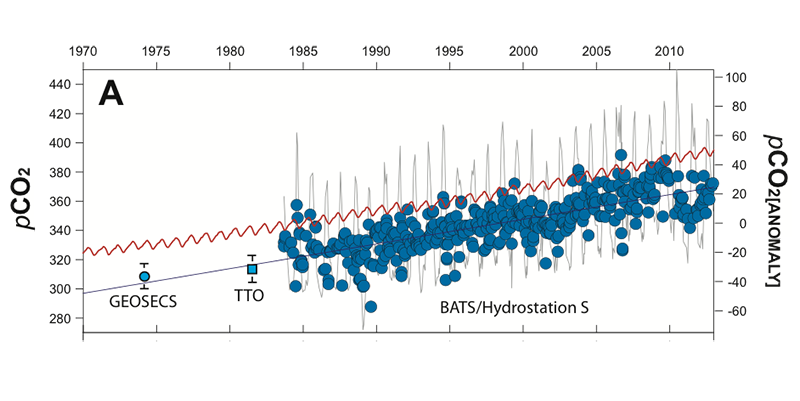
example. BATS scientists have also focused on carbon exchange between
the oceans and atmosphere, seeking an understanding of how oceans
respond to the clear impact of humans on atmospheric carbon dioxide.
Carbon removal pathways from the surface ocean that were poorly
quantified a decade ago — "active carbon transport" by migrant
zooplankton and food web influences — have emerged as significant terms
of the Biological Carbon Pump.
The BATS team continues to explore open and active oceanographic
questions, and to integrate new methodologies. By maintaining an
innovative approach to ocean science, we preserve our position on the
cutting edge of this vast and exciting discipline.